Court of Appeal Applies SLAPP Law to Zimbabwe Case

The California Court of Appeal has interpreted the term “official proceeding” as used in Code of Civil Procedure section 426.16 (the anti-SLAPP statute) to include even foreign litigation. The fact pattern here is rather involved, but to summarize, the action began in Zimbabwe when a wife allegedly took marital property to various locations in that country and then fled with her children to Northern California. The husband was convinced that his sister-in-law had assisted with the removal of the property, so he obtained a “writ of arrest” against her and she spent the night in jail. After a contested hearing, the Zimbabwe court found that there was insufficient evidence to prove that the sister-in-law had assisted in the removal of the property.
The sister-in-law then filed a civil action against the husband in Los Angeles Superior Court for false arrest. A jury found in favor of the husband, but the Court of Appeal reversed and ordered a new trial for various reasons. Back in Zimbabwe, the husband filed for permission to appeal from the final judgment on the arrest case. That application was supported by several declarations, including one from the husband’s California attorney, Donald C. Randolph of Randolph & Associates. The Zimbabwe court denied the application, and the sister-in-law then sued Randolph for malicious prosecution back here in California.
Quite appropriately, Randolph brought an anti-SLAPP motion seeking to strike the malicious prosecution complaint. Clearly, the declaration provided by Randolph was related to litigation and was in furtherance of a right of redress, even if that right was being pursued in Zimbabwe. Unfortunately for Randolph, Los Angeles Superior Court Judge Mel Red Recana was unwilling to take Section 426.16 that far, and denied the anti-SLAPP motion, concluding that it did not apply to activity in a foreign country.
But the Court of Appeal looked at the controversy from a slightly different angle. Although the declaration was provided to a court in Zimbabwe, it “contained statements about the effect of the Zimbabwe order in the Los Angeles case and the facts supporting probable cause for the writ of arrest,” which “were made in connection with issues under consideration in the Los Angeles case.” On that basis, the justices concluded, the statements were made “to influence the determination of issues pending in the Los Angeles case,” and therefore were a part of the right of petition in the Los Angeles case.
The story was reported by the Metropolitan News-Enterprise and can be found here.
“Stealth” SLAPP Suit Victory

One of our latest anti-SLAPP victories provides a beautiful illustration of a “stealth” SLAPP suit that the plaintiff’s attorney failed to recognize, to the great expense of his client.
In this case our (future) client’s business partner, we’ll call him Freddy Fraudster, opened a credit card account at a local bank using our client’s personal information. When our client discovered what Freddy had done, he contacted the bank and informed the personnel there that Freddy had committed fraud, and based on this report the bank closed the account and reported the matter to the police. Our client also filed a police report, and filed for a restraining order against Freddy.
Freddy was not happy. He had a long term relationship with the bank, and based on the report by our client, the bank closed his accounts and would have nothing further to do with him. Apparently thinking the best defense is a good offense, and hoping that winning the race to the courthouse might give him some leverage, Freddy filed an action against our client. He claimed that our client had authorized him to open the account, and that the report to the bank was therefore defamatory since it accused him of fraud.
Do you see why Freddy’s action in Superior Court was a SLAPP suit? Opposing counsel didn’t, but we recognized that this was a SLAPP suit and successfully brought an anti-SLAPP motion. You see, a SLAPP suit is one that tries to block a person’s right of petition. Freddy’s attorney realized that the report to the police and the application for the restraining order were protected rights of petition, but he mistakenly thought that the report to the bank, requesting that the credit card be cancelled, was not a petition for redress and therefore did not fall under the SLAPP statute because it did not involve any government agency. No doubt, he thought that by suing our client for defamation, he could make all his evil deeds go away and get back in good stead with the bank by offering to dismiss the case if our client would withdraw his remarks to the bank, court and police. Now it sounds like a SLAPP, doesn’t it?
The interpretation of the SLAPP statutes by Freddy’s attorney was far too narrow. Consider. One day you run a credit report on yourself and you find that someone has fraudulently opened a credit card in your name. What is the first thing you are going to do? Call an official government agency? You might do that eventually, but first you are going to call the credit card company and tell them to cancel the card. Thus, contacting the credit card company, or in our case the bank, is a natural part of the entire “right of petition.”
It’s very similar to the litigation privilege. I occasionally see cases where a defendant tries to sue the plaintiff and his attorney, claiming that the demand letter sent by the attorney was defamatory because it falsely claimed the defendant did something illegal. But under Civil Code section 47, anything said in conjunction with litigation is privileged and therefore not defamatory. The demand letter from the attorney takes place before legal action is ever filed, but it is still part of the litigation process.
So it was here. The report to the bank occurred before any “right of petition” was pursued with a government agency, but calling to cancel the credit card was a natural part of that process. If a plaintiff were permitted to SLAPP a defendant by focusing on the activities leading up to the actual right of petition, then the intent of the anti-SLAPP statutes would be subverted. We explained that to the court, and our motion was granted.
Law Student Blogger Fights to Remain Anonymous
As I’ve discussed here before, there is a constitutional right to remain anonymous on the Internet. The concept harkens back to the days of “pamphleteers” — those who would distribute anonymous pamphlets, usually criticizing the government. The authors of these pamphlets needed to remain anonymous lest they be harassed by the government officials they were criticizing. Any requirement that pampleteers sign their work was deemed to be an unconstituional violation of the First Amendment.
Today’s pamphleteers use the Internet, and sometimes have a compelling need to remain anonymous. Even if their tomes are not directed at the government, they may feel the need to, say, report unsafe working conditions at their place of employment. We certainly would not want to require someone to disclose their identity under such a circumstance, nor should we permit the subpoena power to be used to determine such a person’s identity.
On the other hand, we cannot allow unfettered defamatory speech. So, to protect both interests, the courts have determined that a poster has the right to remain anonymous, unless and until the person or entity seeking that person’s identity makes a preliminary showing that the speech is defamatory.
This is a reasonable compromise. I have never had a court deny my request for the information when I am on the plaintiff’s side. The reason is simple. I don’t bring frivolous actions. If I’m suing for defamation, then it will always be the case that I can make a showing that the speech is defamatory. Conversely, other attorneys do not have such high standards. I have successfully quashed subpoenas and thereby blocked the disclosure of client information, by showing that the statements made by my anonymous clients are not defamatory.
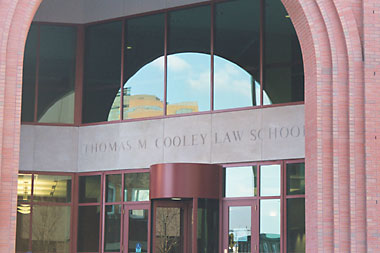
Which leads me an article I saw today that involves all of these issues. It seems that a law student at Thomas M. Cooley Law School was not happy with that institution, and started a blog called Thomas M. Cooley Law School Scam, telling tales of wrongdoing. The school was not amused, and sued the anonymous author as a DOE defendant, and is now seeking the identity of that student. The student is fighting to remain anonymous. Read the article if you want to see how this all plays out.
In an interesting twist, the school did learn the identity of the student through some confusion by the Internet service provider over whether the subpoena was being challenged, and even put his name in some court records that could be accessed on-line. However, the attorneys representing the student convinced the court to unring the bell and remove his name from court documents. If the school cannot show the postings were defamatory, the case will have the interesting result of having to be dismissed because the identity of the DOE is unknown, even though in reality it is known. (Although, if the school can’t make that showing now, there is no reason to assume it would be successful at trial.)
Anti-SLAPP Victory — The Case of the Outraged City Council Member
In this case, our (future) client addressed a city council meeting on a matter she felt was important to the city. Specifically, the city had been rocked by some controversy involving city council members, and our client was speaking to the issue of how the newly-elected council members should go about performing their duties. To illustrate the point, she cited the example of a former council member who had taken money from special interests. The city council member in question took umbrage with the accusation that she had acted unethically, and sued our client for defamation for the comments she had made at the city council meeting. We were retained to fight the defamation action.
It is seldom that we are presented with such a clear SLAPP suit. SLAPP stands for Strategic Lawsuit Against Public Participation. What better example of public participation is there than a citizen addressing their city council? Indeed, under Civil Code section 47, any comments made during a “legislative proceeding” are absolutely privileged (meaning they can never be defamatory). Better yet from the standpoint of an anti-SLAPP motion, section 425.16(e)(1) provides that statements made before a legislative proceeding are protected speech.
So let’s run the facts through the two prongs of the anti-SLAPP analysis. First, as counsel for the defendant, it was our burden to show that the speech was protected within the meaning of the anti-SLAPP statute. That was a no-brainer in this instance, since the words were spoken at a city council meeting. And since the conduct falls under a specific anti-SLAPP section of 425.16, there was no need to show that the topic was a matter of public interest. “Any matter pending before an official proceeding possesses some measure of ‘public significance’ owing solely to the public nature of the proceeding, and free discussion of such matters furthers effective exercise of the petition rights § 425.16 was intended to protect.” (Briggs v. Eden Council for Hope & Opportunity (1999) 19 Cal.4th 1106, 1118.)
Our having shown that the speech was protected, the second prong of the anti-SLAPP analysis requires plaintiff to show a reasonable likelihood of success on her claim, which in this case would be impossible. Since section 47 makes speech at a city council meeting absolutely privileged, the speech by definition cannot constitute defamation.
So a slam-dunk anti-SLAPP motion, right? Not quite.
A SLAPP motion puts a stay on all discovery, which is one of the primary benefits of an anti-SLAPP motion because it keeps the plaintiff from using the discovery process as a sledgehammer to try to wear down the defendant. In this case, counsel for Plaintiff had served discovery prior to the anti-SLAPP motion, and argued that the court should permit that discovery prior to ruling on the anti-SLAPP. There is authority for the proposition that a plaintiff should be permitted to conduct discovery to determine whether the defendant acted with malice, because that takes away certain privileges under section 47. However, there is no malice exception for words spoken at a city council meeting, so no amount of discovery by the Plaintiff could have revealed information that would have defeated the anti-SLAPP motion.
Nonetheless, the court granted Plaintiff’s request for discovery, and that added two months to the process. It could have been that the court just did not understand the authorities we provided, but more likely the court was bending over backwards to give the plaintiff access to discovery, specifically because the judge knew she was going to grant the motion, and did not want Plaintiff to have any possible basis for appeal. In that sense, the judge might have done us a favor, but it is frustrating to deal with a frivolous action for an additional two months. We were successful, though, in greatly limiting the discovery. The court denied Plaintiff’s request to take our client’s deposition.
As expected, the discovery revealed nothing useful to the Plaintiff. Instead, the Plaintiff attempted to argue that the conduct by Defendant was “illegal” and therefore not protected. This was another instance where there is authority for the proposition being claimed, but that legal theory had no application to the case at hand. In the case of Flatley v. Mauro, an attorney had sent threatening letters to someone, threatening to sue him if he did not pay a large settlement to a client. Normally, a letter from an attorney in anticipation of litigation would be protected speech under the litigation privilege, but the Flatley court ruled that the attorney’s letters had risen to the level of extortion, and were therefore illegal and unprotected.
Plaintiff was trying to say that our client’s speech at the city council meeting was illegal and therefore unprotected according to Flatley. And how could speech at a city council meeting ever be illegal, you ask? According to Plaintiff, it was illegal because the city council’s own guidelines state that comments should be civil, and in Plaintiff’s opinion Defendant’s comments had not been civil.
Predictably, the court understood that even if the words were interpreted to be rude, a city council’s guidelines do not amount to law, and violating them does not amount to criminal conduct. The court granted our anti-SLAPP motion, striking the defamation complaint and entering judgment in our favor. The court also awarded us over $18,000 in attorney fees against the Plaintiff.
[Update — October 14, 2011] The council member did not write us an $18,000 check. We had to garnish her wages, and she represented herself in court seeking to reduce the amount being deducted from her paychecks. To her credit, we were seeking $800 per check but she persuaded the court that given her financial circumstances it should be reduced. She was asking that nothing be taken, but the Court settled on $500 per check (every two weeks). I bring this up only for the lesson it offers. It is outrageous that a politician would try to use legal action to silence a critic based on something said at a city council meeting. The judgment is not so large that it will have any significant impact on her finances, but it is good to know that each of her next 40 or so paycheck stubs (adding costs and interest) will provide a reminder that a frivolous action has consequences.
Anti-SLAPP Victory — “If You Sue Me, I’ll Sue You!”
This case was especially satisfying because it was not a classic anti-SLAPP case involving defamation, but we persuaded the judge that the matter fell under the anti-SLAPP laws.
SLAPP stands for Strategic Lawsuit Against Public Participation. A “SLAPP suit” is one designed to silence a defendant, to prevent him from criticizing the plaintiff or, in this case, to keep him from taking a matter to court. Here, our (future) client had entered into a settlement agreement with the defendant in a prior action. The settlement agreement required the defendant company to pay damages to our client, and contained a confidentiality agreement. Two years after the settlement agreement was signed, the defendant had still not paid the damages to the plaintiff, so he retained our firm to sue to collect the money due under the agreement.
After the defendant company could not be persuaded to pay the money voluntarily, we filed an action for breach of contract, attaching a copy of the settlement agreement. The defendant answered the complaint and also filed a cross-complaint, claiming that it was a breach of the confidentially agreement to attach the settlement agreement to the complaint. Incidentally, counsel for defendant had discussed with me his intention to cross-complain on this basis, and I had warned him that would be a really bad idea. He did so anyway.
The reason the cross-complaint was a bad idea is because it was a SLAPP. Do you see why? Remember again what SLAPP stands for – Strategic Litigation Against Public Participation. Defendant had breached the settlement agreement, so clearly we were entitled to sue for breach of that contract. That is the public participation – taking a case before a court for redress of a grievance. By turning around and cross-complaining that our client had breached the agreement by revealing its contents in court, Defendant was in essence suing our client for suing. Attempting to punish someone for suing should always raise SLAPP concerns, but defense counsel filed the cross-complaint anyway, even after my warnings. We filed our anti-SLAPP motion against Defendant/Cross-Complainant for the cross-complaint.
So let’s run this case through the two-prong, anti-SLAPP analysis. Our burden was to show that the speech was protected under the anti-SLAPP statute. The speech here was the complaint itself, with the settlement agreement attached. Filing a complaint is a specifically protected activity under the anti-SLAPP statute, and comments made in conjunction with litigation are protected under Section 47. There was no issue that our complaint was a protected activity.
That takes us to the second prong, by which the plaintiff, here the cross-complainant, must show a reasonable likelihood of success on the merits of the case, even if the speech is a protected activity. Our client was required to keep the agreement confidential in exchange for payment of the damages. But the company never paid the money, so our client was excused from performance. Further, to sue for breach of contract, a plaintiff must allege the terms of the agreement. Here, there was no way to allege a breach of contract without specifying the terms of that agreement. The company argued we should have sought to bring the complaint under seal so no one would ever know the terms, but there is not such obligation required under the law.
But the company had an even more fundamental issue with its cross-complaint. The elements of a breach of contract claim are (1) a contract; (2) a breach of that contract; (3) performance by the plaintiff; and (4) damages from the breach. The company was alleging breach of contract, but it had utterly failed to perform. I attached a declaration from our client saying he had never been paid, and the company could say nothing to refute that point. Thus, the company could never prevail on its breach of contract claim because it could not satisfy the performance element.
The court granted our anti-SLAPP motion, threw out the cross-complaint, and the company is on the hook for more than $15,000 in attorney fees.
[UPDATE — October 14, 2011] This was a strange case. Despite the anti-SLAPP victory, counsel for the company just refused to acknowledge the findings of the court. During settlement discussions, he would always bring up the fact that his client was going to sue for breach of contract for our disclosure of the settlement agreement, even though that claim had already been denied by the court. He maintained this position right up to trial, offering on the courthouse steps to pay our client a fraction of what he was owed in exchange for a promise that the company would not sue on this non-existent claim. When we refused, defendant responded by agreeing to a stipulated judgment in the full amount we were owed. I suppose that the strategy was to wait until the last possible moment in the hope that we would blink (many attorneys will do anything to avoid going to trial, but I am not one of those attorneys), but since the agreement contained an attorney fees clause, all this accomplished was a much higher fee award. To quote John Lennon, “Strange days indeed, most peculiar, Mama.”
Defamation Trial: Paralegal Taught Lesson in Reality
I am very selective with the cases I take, and will only represent the side of a case that should win if justice is done. Out of the many cases I turn down every week, I know that most of the rejected clients will continue to call other attorneys until they find an attorney with less stringent standards; an attorney who does not understand defamation law and/or simply does not care about the merits of the case, so long as he is paid. I then envision the horrible train wreck that is waiting at the end of that track.
Today I happened to come across a news story, reporting one of those train wrecks.
The case involved a scorned woman. She worked as a paralegal, and ended up dating her attorney boss. As is often the case when a supervisor dates a subordinate, the situation gets a little sticky when the employee is not doing her job, and the boss must discipline her. In this case, according to testimony at trial, the paralegal made a serious mistake, and after the attorney blasted her over the mistake, she became so belligerent that he sent her home for the day to cool off.
The paralegal would have none of that. She claimed that he had fired her, and sued for sexual harassment and wrongful termination, claiming that he terminated her because she would not continue a sexual relationship with him. He claimed that he never fired her, and that it was he that had broken up with her because she kept telling him he was fat. The attorney counter-sued the paralegal for defamation on the grounds that she was going around telling people that he was a sexual predator.
The result? The jury rejected all of the paralegal’s claims, but awarded the attorney $1.15 million in damages for the defamatory statements. As this is being written, the jury is in chambers, deciding how much to add to that figure for punitive damages.
Lesson to learn? Make sure you can back up your version of the facts before venturing into the legal process, especially if you are contemplating suing an attorney. I never would have taken this case because of the huge holes in the facts. You say you were fired? Can you please produce the termination documents one would normally expect to see in the case of a termination? Had you reported this alleged sexual harassment to anyone prior to the day he sent you home?
[Update] The jury came back and awarded $100,000 in punitive damages. Counsel for the paralegal filed a motion for new trial, with a rather novel theory. Her comments about the attorney being a sexual predator were made to other attorneys. Therefore, her counsel argued, the comments should be protected by the attorney-client privilege. Novel, but I doubt it will fly.
Privileged Statements Become Defamatory Outside Court

Thinking about yesterday’s post, I thought I should add one more point to the discussion of how false statements made in conjunction with a court action cannot form the basis for a defamation lawsuit.
I explained that under California Civil Code Section 47, and similar code sections in probably every other State, declarations made as part of a legal action are privileged, and therefore do not constitute defamation, since by definition defamation must consist of a false, unprivileged statement.
And the definition of a “legal action” is very broad, and can include statements made in anticipation of litigation. For example, Joe Client goes to an attorney and falsely tells him that Jane Defendant embezzled money from the company. The attorney sends a nasty letter to Jane, setting forth the lie about the embezzlement and stating that if she does not return the money in ten days, he will be filing a lawsuit against her.
Can Jane sue for defamation? After all, Joe Client just told a lie about her to a third party, the attorney. The answer is no. The statements to the attorney were made in anticipation of litigation, and are therefore privileged. (But whether a statement was made in anticipation of litigation can be a hotly contested issue, so be sure to run it past an attorney.)
But it is often the case that someone who lies in conjunction with litigation, will not confine himself to telling those lies only in conjunction with that litigation. As an example, I offer the current divorce case of singer Paul Anka versus his wife, Anna Anka. Paul claims they had a prenuptial agreement, Anna says they did not. She claims that if he produces a signed prenuptial agreement, that will mean he forged her signature because she never signed such a document. (I have no idea who is telling the truth, and offer the case only as an illustrative fact pattern.)
Falsely accusing someone of forgery is defamation, but not if it is said in court. So, she can sign court declarations all day, and testify on the stand, that Paul is a forger, and there would be nothing he could do in terms of defamation.
But Paul is suing for defamation, because he claims she made the statement, or at least implied it, to reporters. Such a statement, if she made it and if it is false, is pure defamation that enjoys no immunity since it was made outside the litigation context.
When clients call to say they want to sue because of lies contained in a court document, I explain why that is not possible, but tell them to be on the look out for the statement being made outside of the litigation. It is often the case that the person will have told the same lies to friends or neighbors, posted them on a blog, or published them via Facebook.
Single Publication Rule Found to Apply to Internet

I get calls every week from people wanting to sue for defamation for something that was said in a declaration. The declaration may have been filed in support of a restraining order, or in family court where parents are fighting over custody of their children. The declaration includes terrible lies about the caller, so he or she wants to sue for defamation.
No can do.
For a statement to be defamatory, it must be unprivileged. Public policy and statutes create a number of privileges that keep a statement from constituting defamation. For example, in California, and likely every other State, a statement made in conjunction with a legal action is privileged, and therefore immune from any claim of defamation. It may be hard to swallow that people can lie about you in a declaration and yet be immune from a claim for defamation, but it has to be that way. Imagine the backlogs that would occur in the courts if every declaration filed yielded another lawsuit for the lies allegedly told in the declaration. Indeed, if suing for something said in a declaration was permitted, then you would be compelled to sue every time the other side filed one. After all, if you didn’t, the Court would have to view that as an admission. Of course, the newly filed lawsuit would generate declarations, so that person would now file another lawsuit, and so it would go, ad infinitum.
When I explain this reality to callers, I generally get a response that goes something like this:
“So you’re telling me, she can say ANYTHING she wants to, and there’s NOTHING I can do about it?! She can claim I’m a murderer, and I just have to take it. She can claim that I rob banks and molest my children, and I just have to smile. Is THAT what you’re telling me?”
No, that’s not even close to what I am telling you. You can’t sue for defamation, but that doesn’t mean you have to take it. You don’t need to file a separate lawsuit for something said in a declaration, because you are already IN a lawsuit. That’s why litigation is called an adversarial system. Your ex-wife files a declaration saying you beat the children, you respond by filing your own declaration saying you don’t, supported by additional declarations from friends and family saying they have never seen you mistreat your children. Every trial involves witnesses testifying to very different versions fo the facts, and the judge has to decide whom to believe. Conflicting declarations are no different.
Plus, lying in a declaration is called perjury. That’s a crime. So, your spouse doesn’t get to say ANYTHING she wants, because she can go to jail. Admittedly, declarants are seldom prosecuted for perjury, but if they tell lies, they lose credibility with the judge and lose the case because your skilled attorney will show them to be the liars they are.
So, back to the Wisconsin case.
The case involved a defamation action against the Milwaukee Brewers and its longtime radio commentator, Bob Uecker. In 2006, Uecker sought an injunction against someone named Ann Ladd, claiming Ladd was harassing him. Ladd was charged with felony stalking around the same time. That criminal charge was dismissed, but the civil court issued the injunction requested by Uecker against Ladd.
Ladd then filed a defamation lawsuit against Uecker, claiming the declaration he provided in support of the injunction was defamatory. But we know a declaration filed in court can’t be defamatory because it is privileged. The judge knew that too, and held that the allegations failed to state a claim because they were privileged. (See, I don’t make this stuff up.)
But as judges often do, he continued to analyze the case under other considerations. The declaration by Uecker, which is a public document, had been published on the Internet at thesmokinggun.com. Ladd was suing for that publication, but it had occurred more than two years prior to the time she brought her action, and would therefore be barred under Wisconsin’s statute of limitations. Ladd argued that the statute had not run, because the declaration was still available on the site, and that every time someone saw the continuing publication, that started a new limitation period.
The court did not agree. It chose to follow the “single publication rule” which holds that, like something published in a newspaper, an article published on the Internet starts the statute of limitations clock running, and that clock is not reset every time someone sees the article, or even when it is republished by another site. If such were the case, the statute of limitations would go on forever on the Internet.
Communications Decency Act Still Unknown to Many Attorneys

It seems like every few weeks I have to rail against a lawsuit I read about, wherein the attorney representing the plaintiff brings an action that is clearly barred by the Communications Decency Act. In this latest installment, we find a New York attorney who represents plaintiffs who appear to have a solid case against some individual defendants resulting from some truly horrific defamation on the Internet.
But the attorney could not leave it alone. I can almost see his mind working. He thinks to himself, “these individuals will never be able to pay the judgment, so I’d better look around for some deep pockets.” So, in addition to the individual defendants he names ning.com, wordpress.com, twitter.com, and my personal favorite, godaddy.com.
I sometimes use the analogy that naming a Internet Service Provider in an Internet defamation action is akin to naming Microsoft as a defendant because the defamer used Word to type the defamatory statements. I never thought any attorney would actually go that far, but the attorney in this case surpasses even that far flung analogy. I know it’s a foreign concept to some attorneys and their clients, but a defendant should only be held liable for damages if he, she or it has done something wrong. Here, twitter.com is named because the defendants sent out “tweets” sending their followers to the defamatory content. Godaddy.com is named because the defendants obtained the domain name there, and then set it to forward to their blog on wordpress.com. How could these companies possibly be liable? Well, according to plaintiffs and their attorney, they are liable because what the defendants did amounted to an “irresponsible use of technology.”
Apparently, in this attorney’s world, we have gone beyond even requiring that the website provider check the content of every web page posted on its server. Now it is also the obligation of twitter.com to review and authorize every tweet that is sent, and godaddy.com must view with suspicion every account that sets a domain name to forward elsewhere. Clearly there could be no Internet if such duty and liability could be imposed.
In (very slight) defense of the attorney, he does allege that these companies were informed of the nefarious use of their services, and did nothing to block the content. Among the public there is an urban legend that a company becomes liable once it is informed that it is being used to distribute the defamatory content, but an attorney should know better.
A copy of the complaint can be found here, and a detailed article about the case can be found here.
Tony La Russa Drops Action Against Twitter

Even when a lawsuit is weak on merit it sometimes achieves its purpose. I will have no part in filing a meritless lawsuit, but sometimes it is appropriate to push the envelope.
Take the case of Tony La Russa, famous baseball manager. Like so many other well known people, someone hijacked his name and image on Twitter, leading many “followers” to believe that the musings coming from this Twitterer (Twitterite?) were coming from the real deal. La Russa tried to persuade Twitter to intervene and remove the fake identity, but sure as there is a fail whale, the fine folks at Twitter refused to cooperate.
La Russa filed suit and got a lot of grief for doing so, with most legal experts citing the Communications Decency Act (CDA) as a barrier to the suit. But, obviously, this is not a typical CDA situation. Yes, La Russa was seeking to hold Twitter liable for the “postings” of third parties, and that is classic CDA material. But there are some interesting side issues. For example, a website cannot encourage visitors to post copyrighted e-books for download and then expect to escape liability under the CDA because third parties are the ones actually posting the books. In that case, the Digital Millennium Copyright Act would trump the CDA. Like a copyright, people have a pecuniary interest in there own identities. Should Twitter be permitted to assist in those that would steal that identity?
The La Russa case will not be providing any answers to this question, because it has been withdrawn, but not before Twitter deleted the offending account. Most are reporting this story as a victory for Twitter, but didn’t La Russa get exactly what he asked for in the first place?
For more on this story, go here.