How to Respond to a Cease and Desist Letter
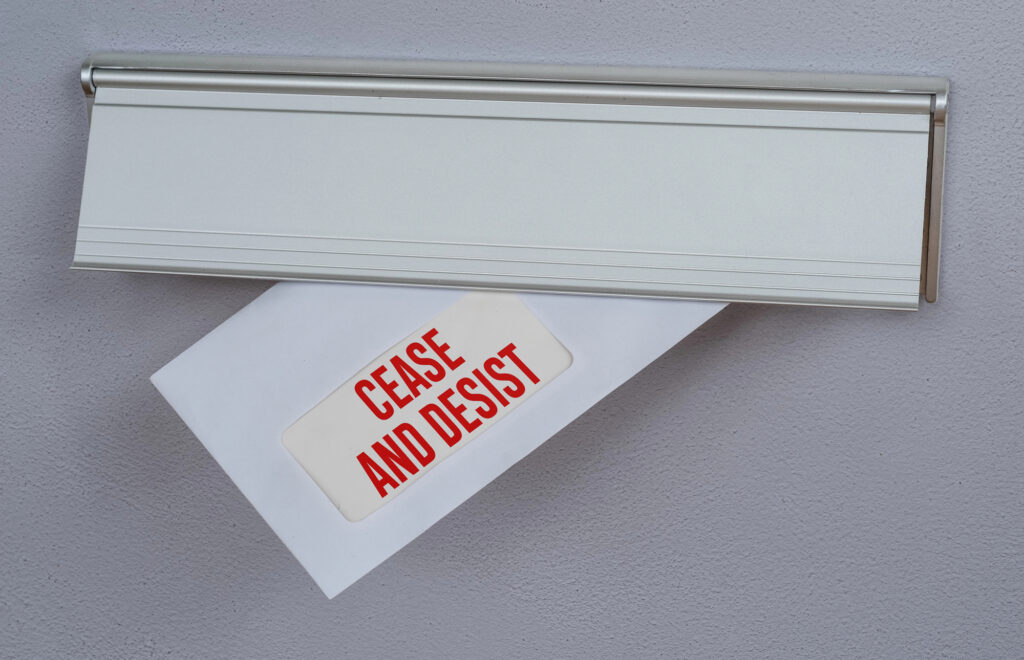
I am frequently consulted by potential clients, who call to ask how best to respond to a cease and desist letter from an attorney, that claims the caller is guilty of defamation or some other wrongful act. The letter demands that the defamatory remarks be removed and/or the wrongful conduct cease immediately, and typically states or implies that legal action will follow if the demand is not honored.
The problem is, the caller did not make the remarks (or they were entirely truthful) and/or did not engage in the wrongful conduct. The caller is hopping mad that some attorney, without even asking the caller for their side of the story, is making these spurious claims. The caller wants to know how they should respond to the letter.
The answer is that there is no way to know the best way to respond. Thanks from coming. Be sure to tip your server.
But I can tell you this . . . .
The answer to the question depends on many variables, some of which are unquantifiable. So this is a question where the best lawyerly answer I can provide is, “it depends.” I can, however, offer the following list of factors to consider in determining how best to respond to a cease and desist letter.
The letter is not defamatory.
Let’s first get this point out of the way. Callers often want to sue the attorney and his or her client for defamation for daring to send the letter containing such false accusations. But the letter was sent to you, and you can’t be defamed to yourself. Defamation requires publication to a third party.
If you look down at the bottom of the letter and see that it is copied to a third party, that could conceivably be the basis for a defamation action, but probably not. People often add a “cc” to a letter just to make it appear more intimidating, as in, “I am really serious about this to the point that I copied the Federal Trade Commission on this letter.” It doesn’t mean that the FTC was really copied, or bothered to read it.
And, no, the fact that the clients told these horrible lies to the attorney so that he or she could write the letter will not be enough. Communicative acts done in anticipation of possible litigation are protected by the litigation privilege (Civil Code § 47). If you sue for what is stated in a cease and desist letter, you’ll almost certainly be met with an anti-SLAPP motion and end up having to pay the other side’s attorney fees (Code of Civil Procedure § 425.16).
There are exceptions to every rule, as in the case where an attorney’s letter went so far that he was successfully sued for extortion, so by all means have an attorney review the letter, but it is extremely unlikely it will form the basis for an action.
The letter may be a toothless threat.
Cease and desist and demand letters are a nice source of income for attorneys. I know of an employment attorney who charges $5,000 for a letter, and his clients are happy to pay it. After being told by 20 attorneys that due to the law regarding at-will employment they have no claim, they finally find at attorney willing to write to the employer and “give them what for.” The hope is that the letter might scare the employer enough that they pay some money to avoid the threatened legal action.
But that attorney seldom, if ever, follows through on the threat. And that is often the case with attorney letters, especially in the defamation context. The letter is sent in the hope that the person will stop saying whatever it is they are saying about the attorney’s client, but the attorney may have already concluded that it would not make economic sense to pursue the action, or that the statements do not support a defamation claim.
Look at it this way. If goal is to silence the alleged defamer, wouldn’t an actual lawsuit be far more effective? Or the attorney could send a cease and desist letter along with the unfiled complaint. It only takes a little longer to put the allegations in a complaint, as opposed to a letter.
Attached hereto is the complaint we intend to file if you do not remove your Instagram post about our client within five days.
Isn’t that far more threatening? The recipient sees that the plaintiff has already taken the time to prepare the complaint, and is ready to pull the trigger. The fact that the attorney and client elected instead to proceed by way of a letter is an indication that they want to avoid litigation.
Or they could be setting a trap.
On the other hand, a cease and desist letter is a fast way to draw a line in the sand, and to set up certain arguments that can later be made at trial.
If you comply, that will be used against you.
So you receive a letter, demanding that you remove an allegedly defamatory review you posted on Yelp. Even though everything you said is true, you decide it just is not worth fighting about, so you immediately remove the review. If the plaintiff does sue you, he will almost certainly claim at trial that you removed the post because you knew what you said were lies.
If you don’t comply, that will be used against you.
Conversely, if you don’t comply with the request to remove the review, that will be used against you as well, especially if anything you said is found to be defamatory. Given the backlog caused by Covid, it now takes around 18 months to get a case to trial. If you don’t comply with the request, plaintiff’s counsel will argue to the judge or jury that punitive damages are appropriate, because even after you were nicely asked to remove the comments, and told why they were false and defamatory, you left them up for the next 18 months.
You can do nothing, and see what happens.
Nothing says that you must respond to a cease and desist letter. As I explained above, if they really intend to sue, they would just sue. If the letter says they won’t sue you if you do what they ask, you can do nothing and see if they make good on the threat. If they were willing to walk away before the lawsuit, they will probably still be willing to do so after filing the complaint, if you then comply with the demand (although they might then demand reimbursement of the fees and costs they have incurred).
Consider how your silence will be perceived.
There is a maxim of law that silence does not mean consent. Under the law, if someone says you are lying, and you do not respond, that does not mean that you agree you are lying. But in the real world, that is not the case. We expect people to stand up for themselves.
I remember something a Judge said to me in Federal court. I represented the defendant in the case, and the plaintiff’s attorney sent discovery, seeking a certain document. My client informed me that no such document ever existed, and we responded as such.
Plaintiff’s counsel wrote twice more, demanding the document, and I responded each time that according to my client, the document had never existed. Plaintiff’s counsel wrote a third time, this time threatening to bring a motion to compel, and to seek sanctions against the client and I, if the document was not produced. I responded again that, according to my client, the document did not exist, and that if she thought a motion to compel was warranted, she should file the motion, but that I would have no further communication with her about that nonexistent document. The attorney wrote to me 18 more times about the document, but never brought the threatened motion to compel. As promised, I did not respond to any of her 18 subsequent demands.
At a status conference, opposing counsel pulled out the 21 letters demanding the document, and the exchange went something like this:
Opposing counsel: Your Honor, I’m sorry we are not further along in the litigation, but defendant and his counsel are not cooperating in the discovery process. I have written to Mr. Morris 21 times demanding production of this document, and he has never produced it. In fact, the last 18 times I have written to him, he has not even shown me the courtesy of replying.
Judge: Is that true, Mr. Morris?
Me: Partially, but Ms. Jones left out crucial facts. After I responded to her three times that, according to my client, no such document has ever existed, I told her she should bring a motion to compel if she deemed that to be appropriate, but that I would have no further communication with her regarding the document. I consider it unethical to allow opposing counsel to generate unnecessary fees for my client, and often that is the specific intent of making the same demand so many times. I had already informed her of our position regarding that document, and incurring the time and expense of responding to her 18 more times, after specifically informing her that I would not do so, would not be appropriate. And, you’ll note, Ms. Jones never brought a motion to compel, as I suspect she is well aware that the document never existed.
Judge: I practiced many years before joining the bench, and I never would have failed to respond to a letter. I mean, 18 times she accused you and your client of acting in bad faith by failing to produce this document, and you never responded. That makes you and your client look really bad.
The point of this long-winded war story is that while seemingly any rational person would agree that I was under no duty to respond to 18 more letters after I had made our position clear, something was so ingrained in this Judge’s mindset about having to respond to every letter that she concluded that failing to do so made the client and I “look really bad.”
I’m sure this Judge is not the only one who thinks that way. Contrary to the law, if you simply fail to respond to a cease and desist letter, it might be viewed as conceding the points contained therein.
Incidentally, the document in question was not particularly important, and plaintiff dismissed the case against my client about three days after the status conference. I think the case was filed entirely for leverage by making my client incur attorney fees, and seeing that I would not play the game, plaintiff gave up.
If you don’t respond, any chance at settlement may be lost.
Conversely, if you don’t respond, and the plaintiff does file the action, that momentum may destroy any settlement possibilities. It could be that the plaintiff wanted to sue, but the attorney suggested a more measured approach. “Before we incur the costs of preparing and filing a complaint, let me see if I can talk them into just removing the comments they posted.” But then you didn’t even respond, and the plaintiff is now twice as mad. His willingness to walk away is gone.
You can respond without responding.
There is one approach I have used very effectively on several occasions, when the client did not do what is being claimed in the letter.
Let’s say you receive the following letter:
Dear Ms. Johnson,
We represent Dave Jones. Mr. Jones is informed that you have communicated to his neighbors that he is operating an illegal opium den in his basement. If you do not respond to this letter within five days, promising to never again make this claim, we will be forced to bring legal action.
Very truly yours,
Joe Dokes, Esq.
But you never told anyone that Mr. Jones is doing anything illegal. In such a case, there is no problem with agreeing to what is being requested, so long as you make clear you never did it.
Dear Mr. Dokes,
I represent Ms. Johnson, and this letter is in response to your letter dated May 20, 2024. Ms. Johnson has never discussed Mr. Jones with anyone in the neighborhood or elsewhere, and has never stated he is operating an opium den.
Your client will likely want to respond with all the reasons he (erroneously) concluded that Ms. Johnson made such statements, but such response is not necessary. She agrees to your demand to never state that Mr. Dokes is operating an opium den. Based on your letter, we will assume the matter is resolved.
All best,
Aaron Morris
Historically, they almost always respond anyway, to state why they are confident my client did do what was stated in the letter, but that’s as far as it goes. On one occasion, they saber-rattled about how they were now going to sue because my client was failing to take responsibility for what had occurred, but they never did so.
So as I said at the outset, there is no one “best” way to respond to a cease and desist letter, but you now know some of the factors to consider when deciding how to proceed.
You Can Sue for Defamation in Small Claims Court

Wow. I may actually know what I’m talking about.
In one of my earliest postings on this blog (recently updated to reflect the new damage limits), I recommended Small Claims Court to those who have been defamed, but can’t afford an attorney, or where the numbers involved would not justify the expense of an attorney. At the time I wrote that article, the maximum amount of damages that could be recovered was $5,000 as I recall, but it was raised to $10,000 in 2012, and then $12,500 in 2023. (It was originally intended to go to $15,000 that year, but apparently the Governor though that was a little too high.)
Obviously, even with this higher amount, this is not the way to go if you have a case with significant damages, but often the damages are minor, or damages are simply not the victim’s purpose in bringing suit. I suggested that an action in Small Claims Court can be an effective way to stop someone from continuing to defame you, and permits you to respond to anyone who asks you about the rumor, that you sued the defamer in court and won.
I had some secondhand knowledge of defamation actions being brought in Small Claims Court, but since attorneys are not allowed to represent clients there, I will never be able to test my theory directly. I’ve also been slightly concerned because I have received a couple of emails from readers who say that they were informed by a court clerk that defamation actions cannot be pursued in Small Claims Court.
Thankfully, a reader of my original posting was kind enough to call and spend some time on the phone with me, talking about his experiences. A vicious rumor got started about him some time ago, and like the urban legends that reappear periodically on the web, every few months the rumor about this person grows legs and starts getting spread again. Fortunately, because his professional circle is somewhat small, eventually the rumor reaches people that report back to the victim. He then brings a small claims action against the defamer, and has a witness to the statements.
This caller has brought four such actions, and has won every time. The judgments are small, but for the caller, damages were not the goal. He has found that the suits tend to eradicate the rumor in the community pockets surrounding the person who was spreading the lie. In other words, having lost in court, that person then goes back and tells the same people about the lawsuit. No doubt, the story is not told in flattering terms. Most likely the story goes something like this:
“Joe is such an asshole. I told Dave about how I had heard that Joe was stealing from clients, Dave told him what I said, and Joe sued me in court. The judge awarded him $2,500, so now I have to write him a check for $250 every month until it is paid off.”
But despite how the story is being told, the fact is that the people hearing the story are walking away knowing that it was a lie to accuse Joe of stealing, and Joe won’t put up with the lie being told.
This caller’s successes illustrate a couple of points. First, a “republisher” of a defamatory statement – one who simply repeats what he was told – is as guilty as the person who started the false rumor. Our hypothetical Joe may never learn who started the original rumor, but going after those who are repeating the lie is like a firefighter starting a backfire to stop a fire. It can help to stop the spread of the rumor, and may get back to the person who started it and cause him to shut up.
Secondly, and more to the point of this article, you can sue for defamation in Small Claims Court, regardless of what the court clerks may be saying. Defamation is a tort, such as personal injury. Just as you can sue for personal injury in small claims court, you can sue for defamation. If you get any pushback, ask to speak to a higher up, and ask them to show you the court rule that prohibits defamation actions in small claims court. There is no such rule.
However, as I explained in the original article, a judge in Small Claims Court cannot give any equitable relief. In other words, he or she can’t order the defendant to stop spreading the rumor or to provide a letter of apology, as examples. That is why attorneys often don’t think to suggest Small Claims Court and may be why the clerks think defamation actions cannot even be brought there. (Actually, a Small Claims judge can grant certain limited equitable relief, mostly having to do with contracts, and can condition an award on an act. He could, for example, award $5,000 in damages, reduced to $2,500 if the defamatory statement is removed from the Internet.)
For fun, I asked ChatGPT about suing for defamation in Small Claims Court, and it responded, “you generally cannot sue for defamation in small claims court in California.” But its reasoning for that conclusion was what I mentioned above — the inability of a small claims judge to provide injunctive relief such as ordering that the false statements be retracted. In ChatGPT’s “mind,” defamation claims can’t be brought in Small Claims Court because the judge can’t issue any order. But the strategy I am suggesting accepts that limitation in exchange for the far, far, FAR cheaper alternative of suing in that forum.
When I called out ChatGPT and asked if it could provide any authority for the position that defamation actions cannot be brought in Small Claims Court, it had to concede that “there’s no California authority expressly forbidding defamation actions in small claims court.”
And there are other big advantages to Small Claims Court. In many defamation actions, the specter of an anti-SLAPP motion looms large. If you sue for defamation and the defendant successfully brings an anti-SLAPP motion – convincing the court that the speech was protected – you get to pay the other side’s attorney fees. You are safer from an anti-SLAPP suit in Small Claims Court, and in any event there likely would be no attorney fees. (There are almost no absolutes in the law, so although very unlikely, I am not saying someone could not come up with a way to bring an anti-SLAPP motion in small claims court, such as having the action reclassified to Superior Court, or by bringing an oral motion at the time of trial.) Further, you cannot be sued for malicious prosecution if you lose on a Small Claims action.
With all this said, you’ll be wasting your time in Small Claims Court if you think you can go in and wing it. You’ll be suing for thousands of dollars, so it will be time and money well spent if you buy and review Everybody’s Guide to Small Claims Court in California
A word about damages.
More proof that ChatGPT is terrible when it comes to legal analysis comes from its mention of damages. It stated that defamation actions are “not well suited” to Small Claims Court because of the complexity of proving special damages (lost income, business harm). It posited that since actions in Small Claims Court are intended to be brief, proving special damages would be too time consuming. And, rather insultingly to the judges who hear small claims matters, it opined that the issues surrounding a defamation claims are just too sophisticated for that forum. (An example of AI holding us humans in contempt?)
With all due respect to our future AI overlords, ChatGPT utterly failed to recognize the two types of damages in a defamation action — actual damages and assumed damages. Actual damages are just what the name suggests; the measurable damages that resulted from the defamation, such as loss of income. But defamation is unique among torts in that if the elements of defamation are proven, the law provides that the plaintiff MUST be awarded damages, even if no economic damages are proven. We as a society recognize that one’s reputation has value, and damages are assumed if one is defamed. These assumed damages include “mental suffering, anxiety, embarrassment, and humiliation” — even absent proof of economic or special damages. If the false statements made about you were significant and sufficiently widespread, the judge is free to award you the full jurisdictional amount based on loss of reputation and the emotional distress you suffered, even if you did not prove a penny of damages.
Think about it.
There are so many aspects to this area of the law, that my articles soon turn into tomes if I don’t control myself. The prior paragraph is an example of where I can’t just let it stand without further clarification, for fear that it will be twisted. Note that I said a statement needs to be “significant and sufficiently widespread.” When considering whether the false statement will support assumed damages, don’t analyze it from the viewpoint of a fragile wallflower who takes offense at every perceived slight. Instead, use the viewpoint of a person who understands that the occasional insult is just part of the background noise of life. If a waiter falsely stated in front of your date that your credit card had been declined, that might technically satisfy the elements of defamation, but no judge is going to be so outraged by that statement as to award you anything beyond perhaps $5 in assumed damages.
Friends and family can be used to determine the worth of a case. Sit them down with some wine and beer (but not too much), tell them you want them to realistically determine the damages, as opposed to saying what they think you want to hear, and tell them the facts of your case. After they provide their damage calculations, ask them to provide their reasoning to see if the damage amount has any relation to reality, or was just pulled out of their butt.
[Update] I had recommended to a caller that her case was perfect for my Small Claims approach. She said the defamer would not stop defaming her, so I suggested that each time she learned of another defamation, she should drag him to court again. Over a year later she was kind enough to call me to thank me for the suggestion. She stated that in the time since she spoke to me, she had sued him multiple times, and had prevailed every time, with total damages approaching $50,000. I thought about that number after the call, initially thinking it was implausible given the limits on damages in Small Claims Court, but I crunched the numbers and it can be done.
Check the current rules, but as I write this, a natural person (as opposed to an entity) can bring small claims actions for the maximum amount of $12,500 up to twice a year, and can bring an unlimited number of cases that seek $2,500 or less. The limitation to two $12,500 actions in a 12-month period is a rolling period measured from the date of filing, not January–December. So, for example, if the caller filed her first $12,500 case on March 1, 2024, and the second one on April 1, 2024, she’d be eligible to file her third and fourth actions on March 2, 2025 and April 2, 2025. So it was entirely possible that she had sued four times and been awarded $50,000 in a little over one year and one month (plus however long it took for the cases to be heard).
And I have to believe that so long as her evidence was strong, the judge would be more inclined each time to award the maximum, seeing that the defendant continues with the same bad behavior. As you can see, a Small Claims action is not only a very streamlined and cost effective way to proceed, it can also be very lucrative.
[Update] As I predicted in my parenthetical above, concerning an oral anti-SLAPP motion, a caller advised me that he was threatened with an anti-SLAPP motion in response to his small claims case. He added that he had gone to court to observe other cases as a way to prepare for his own trial, and he observed a judge grant an oral anti-SLAPP motion in a small claims case. But that’s as it should be. If a plaintiff is suing for damages in Small Claims Court, arising from protected activity, the court should dismiss the action. As a matter of public policy (as set forth in Civil Code § 47 and Code of Civil Procedure § 425.16), the law immunizes people from what they say in certain circumstances. For example, we don’t want politicians to be able to sue their constituents for defamation as a means to silence any criticism. So if you attend a City Council meeting and call the mayor a no good, lying pony soldier, he or she can’t sue you. If they nonetheless tried to do so (which was the exact fact pattern in my very first anti-SLAPP motion), the judge should (and did) dismiss the case.
But a plaintiff would still be far safer in Small Claims Court, since there would be no attorney and hence no attorney fees. But as with anything I write about the law, I can envision possible exceptions. A corporation can’t defend itself in court, because it is not a person and has no mouth. Thus, a human has to be there on behalf of the corporation, and that human could be an attorney, who might try to claim attorney fees following a successful oral anti-SLAPP motion.
How to Stop Defamation When You Can’t Afford an Attorney

Is there a way to stop defamation when you have limited funds to hire an attorney, or the damages you are seeking would not make hiring an attorney economically feasible?
Here’s a call I get a few times a week. Someone somewhere has managed to upset someone else, usually over a miscommunication. Alternatively, it will be an ex-boyfriend, girlfriend or spouse that feels they were done wrong. The offended party responds to the perceived offense by going onto various social networking sites and posting false, defamatory statements; Facebook is a popular choice for the vitriol. The victim of these accusations wants my assistance in getting the statements taken down.
I can do that, but at a cost. And while I sometimes take a case on a contingency basis (receiving a percentage of the amount recovered), most of the time such an arrangement is not workable since the primary goal of the action is to remove the defamatory materials, not for damages. An attorney cannot take a case on a contingency basis if there are no damages or if the defendant has no ability to pay. Indeed, in many instances an attorney should not take a defamation case on a contingency basis since that will then make the case about money instead of being about solutions.
Is there a solution for those who can’t afford representation?
Should You Sue Family Members for Defamation?

If one is asking whether they should sue family members for defamation, I have to wonder what Thanksgiving dinners are like with these families. I get these calls often, and they are very sad because they show an estranged family. In this article, I will discuss whether it ever makes sense to sue a family member.
Common scenarios.
Family disputes arise from a few common scenarios. The one I see most often arises from disputes over property, when a family member feels cheated. For example, Joe moves in with mom to take care of her, and his brother Bill is not happy with the care Joe is providing. Additionally, Bill becomes convinced that Joe’s new found compassion is really about convincing mom to sign over the house. Bill goes to court to seek a conservatorship, and to bolster that claim, he contacts Adult Protective Services, claiming Joe is abusing dear old Mom. Joe wants to sue for defamation for what Bill put in the court documents, and for what he said to the police.
Another common scenario involves a family member with mental issues and/or a drug problem. The family is showing a little tough love in an effort to get the person back on the path, but he takes it as a personal attack. He wants to sue family members for things they have said to doctors and social workers.
And yet another common scenario, the one we’ll use for today’s discussion, involves a wife who is relatively new to the family. Apparently following the reasoning that “no woman is good enough for my ________” (son, brother, nephew, cousin – fill in the blank), a split has formed, with half the family attacking the new bride, and the other half defending her. She has had enough, and calls me, wanting to sue the family ringleader who is saying bad things about her.
Should she sue? Continue reading
You Can’t Prove Slander Without a Witness

You can’t prove slander without a witness.
Let’s begin with some definitions. As you likely know, if one is defamed in writing, that is libel, and if the defamation is spoken, that is slander.
In the case of libel, you can show the defamation by offering the written document. This can make it easier to prove the case, since the evidence is right there in black and white. However, it is not as simple as some assume.
For example, let’s make you Sue Smith, and you live at 123 Main Street. You wake up one morning and while reading the paper over a cup of coffee (yes, there are some of us who still enjoy reading the paper), you come across an article that says, “Police report that Sue Smith, who resides at 123 Main St., was booked on suspicion of drunk driving. Officer Dave Friendly stated that this was Smith’s third drunk driving arrest, making it a felony.” None of it is true. Probably because of some snafu, the police got it wrong.
Do you have a viable defamation action? Most people who call want to sue the newspaper, but for the reasons set forth in this article, most likely that is a nonstarter.
The person who told the lie is Officer Friendly. So can you sue Officer Friendly, since the paper quoted him? Possibly, but even though the defamatory statement is right there in writing, you don’t yet have an action. How do we know Officer Friendly really said such a thing? It could be that the good officer said something completely different, and your action will be against the newspaper for getting it wrong. News outlets are protected when they accurately quote a public official, even if the official is wrong, but they’ll have to show that Officer Friendly really said what he said.
Slander is even tougher. Continue reading
Here is How You Sue the News for Lying

Is that false news really false?
This is another article that callers have compelled me to write, so that I have a resource I can send them to that explains this important point of law.
We begin with Civil Code section 45, which defines libel:
Libel is a false and unprivileged publication by writing, printing, picture, effigy, or other fixed representation to the eye, which exposes any person to hatred, contempt, ridicule, or obloquy, or which causes him to be shunned or avoided, or which has a tendency to injure him in his occupation.
Thus, as a beginning point, a statement must be verifiably false to be defamatory.
But as the rest of the statute makes clear, falsity is not enough. If I publish an article falsely stating that you own a home in Beverly Hills, I have told a lie about you, but it would not be defamatory or actionable. That is the first point that many people struggle with. They grew up hearing “liar, liar, pants on fire,” and they assume that there must be some remedy against someone who tells a lie. (At a minimum, their pants should combust.)
Such is not the case. Lying about your home in Beverly Hills is not actionable, because that claim does not expose you to “hatred, contempt, ridicule, or obloquy, or which causes him to be shunned or avoided, or which has a tendency to injure him in his occupation.” There is simply nothing wrong with owning a home in Beverly Hills.
Now as is always the case in analyzing statements to see if they are defamatory, context is everything. If you were known as the person who swore off all material possessions in order to live with and assist the homeless, and I publish a story falsely claiming you own a home in Beverly Hills, in that context the statement could be defamatory because it amounts to calling you a liar. But the first step in the analysis is to determine if the statement is false, and whether, if taken as true, the statement would subject you to hatred, contempt, etc.
Next comes the part that is at the heart of the article; the issue of what is false in the context of media reporting.
This usually arises from a news story, reporting an arrest. The caller was arrested for, say, credit card fraud. He owns a business, and customers claimed that he was making unauthorized charges on their cards. He is ultimately arrested, and several media outlets report that he was arrested for credit card fraud. And just to set up the story for another point, let’s say he was charged with 15 counts of credit card fraud, but some of the outlets reported it as 20 counts.
Then one of three things occurs. Although he was arrested, the District Attorney takes a look at the case and decides not to prosecute. Alternatively, he goes to trial and is found not guilty. Or, he goes to trial and is found guilty, but the charges are later expunged or he is pardoned.
Now this person calls me and wants to sue the media outlets for defamation, claiming that he never committed credit card fraud, as evidenced by the dropped charges, acquittal, or expungement/pardon.**
The FACT that the arrest occurred is true.
It doesn’t work that way, because the statements by the news organizations were ENTIRELY TRUE. The caller WAS arrested for credit card fraud. Whatever occurred thereafter as regards the caller’s guilt does not negate the fact that the caller was arrested, so the statement was not false.
Sometimes callers cannot be made to see this fact. They argue that they could not have been arrested for a crime they did not commit, so the statement is therefore false. In their minds, the statement, “Joe Dokes was arrested by the Riverside Police for 20 counts of credit card fraud” translates to “Joe Dokes committed credit card fraud.”
Taking it a step further, after I explain the concept of falsity, they will assert that this case is different, because the news came right out and reported that he had committed the crime. They will ask if they can send me the video from the news station, where the reporter supposedly flat-out states that this person is guilty of credit card fraud. I explain, without seeing the video, I can say with 95.7% certainty that the report will contain enough “allegedly” and “as reported” language to make clear that the reporter is not making a claim of guilt, but they assure me such is not the case. I agree to watch the video if they will give me the timestamp for that portion where the reporter looks into the camera and states that they committed the crime.
Every time I have been provided a video where the caller swears that the reporter claims they are guilty of the offense, when I get to that point in the video, is simply says something like, “Police Investigator John Billingsworth stated that the customers claimed that after signing up for fitness training, they would later find charges on their credit card statements for sessions they did not authorize or attend.”
It is surprising to me that after going through the video in the detail necessary to find me the time stamp, the caller still believes that statement is an affirmation that they committed the crime. Unless it is the case that Investigator Billingsworth never made such a statement to the media, then presumably it is true that is what the customers told him, and the media report is therefore, again, entirely true.
That is not to say you can never sue a news outlet. A caller once reported to me that a news commentator identified him by name, stated that he was a member of Al-Qaeda, and implied he had participated in attacks against the United States. I watched the report, and was shocked to see the commentator say exactly that, claiming it was based on his own personal knowledge. It turned out he had confused him with someone with a similar name. We obtained a large settlement for the client, and the commentator was never seen on the air again.
In performing your analysis, look for the disclaimers in the video or article. The format is usually the same. The opening paragraph will set forth the accusation of criminal conduct, and end with, “authorities said.” The next paragraph will throw in additional details about the time, place, and location. In the next paragraph, it’s back to the disclaimers, ending with something like, “police said” or “records show.” Some paragraphs may not contain a disclaimer, but that does not make the article defamatory since the disclaimers in the other paragraphs make clear that the news item is based on third-party statements. Indeed, a news article is never a first-person account unless the reporter claims to have witnessed the crime.
Some attorneys fail to see this as well.
And lest you think this misunderstanding is limited to potential clients, rest assured that many attorneys fail to comprehend this point as well.
A recent example came out of Ohio. There, an attorney was sued by her former client, and the Medina Gazette newspaper reported on the lawsuit, stating that the client had sued the attorney for fraud, breach of duty, and failure to provide competent services. The article then repeated verbatim some of the allegations contained in the complaint.
The attorney sued the newspaper, claiming that it had “falsely accused her of numerous allegations that on their face reflect upon her character in a manner that will cause her to be ridiculed, hated, held in contempt, or in a manner that will injure her in her trade or profession as an attorney.”
The newspaper brought a motion to dismiss, which was granted. The trial court found, as it had to, that the newspaper had accurately reported the basis for the lawsuit, without ever stating that any of the allegations were true.
Still missing the point, the attorney appealed, and the appellate court upheld the dismissal, stating: “[i]t is clear based on a plain reading of the article attached to the complaint that the Medina Gazette does not accuse [the attorney] of mortgage fraud, but rather reports that her former client is suing her for mortgage fraud.”
Showing that she really, REALLY did not get the point, the attorney had argued on appeal that the newspaper was liable for failing to investigate the truthfulness of the allegations before reporting them. The truth of the allegations is irrelevant to reporting that they exist. Only if the newspaper was going to report that the allegations were true, would it then have a duty to investigate whether that was the case.
Another hurdle – The Fair Report Privilege
One more hurdle to suing a media outlet comes in the form of the Fair Report Privilege, set forth in Civil Code section 47, which lists a number of privileges. Stated simply, under subdivision (e), someone publishing information is protected against a claim for defamation so long as they publish “a fair and true report of (1) the proceedings of a public meeting, if the meeting was lawfully convened for a lawful purpose and open to the public, or (2) the publication of the matter complained of was for the public benefit.”
Also, subdivision (d) provides the same protections against legal action for “a fair and true report in, or a communication to, a public journal, of (A) a judicial, (B) legislative, or (C) other public official proceeding, or (D) of anything said in the course thereof, or (E) of a verified charge or complaint made by any person to a public official, upon which complaint a warrant has been issued.”
This can all be summarized as follows. The defendant will be safe from your lawsuit if he can show (1) his source was an official public document or statement by a public official on a matter of public concern; (2) he properly attributed the information to that source; and (3) he fairly and accurately reported the information from the document or statement.
Generally speaking, a person who republishes a defamatory statement is as liable as the person who first spoke the lie. Under that reasoning, if the police falsely told a newspaper that you had committed arson, and the newspaper reported that claim, it would be liable for defamation. BUT, it is because of the Fair Report Privilege that a newspaper would NOT be liable for reporting the false statement of the police.
But what if the story contains false statements?
I already hear the gears turning. Under this last privilege, the statement must be “a fair and true report” of the proceedings, statement, or document. Using our example, what about the point that the some media outlets reported 20 charges, when there were only 15? That’s not true.
The law requires only that the “gist” of the statement be true, and that is determined by whether the statement “would have a different effect on the mind of the reader from that with the pleaded truth would have produced.” Masson v. New Yorker Magazine, Inc. (1991) 501 U.S. 496, 517.
Let me give you a real life example that just came down today.
A CBS station did a story on a pain killer epidemic in West Virginia, detailing how some doctors were allegedly running pain killer dispensaries, assisted by a named pharmacy that “was filling more than 150 pain prescriptions a day from one clinic alone.” The pharmacy sued CBS, claiming that it was not doing anything illegal, and it was certainly not filling 150 prescriptions per day.
The defamation case was dismissed today on a motion for summary judgment, after the court found that the statements, while potentially misleading, correctly captured the “gist” of the situation.
The pharmacy contended that the quoted statement implied that it was filling over 150 pain killer prescriptions per day, when in fact that had only occurred on seven occasions. The court found that this difference between reality and how it was reported would not have a different effect on the mind of the reader.

The Employment Test
I use what I call the employment test, to help callers analyze their case. Let’s use the case of this pharmacist to illustrate the point. Let’s say he is applying to be a pharmacist at CVS, in two parallel universes. In one universe, he tells the interviewer the true version – that he was filling lots and lots of pain killer prescriptions, and on seven but only seven days he filled more than 150 pain killer prescriptions from a single clinic. In the other universe, he provides the media version, telling the interviewer that he “was filling more than 150 pain prescriptions a day from one clinic alone.”
If the CVS interviewer sees such a difference between those two versions, that he or she hires the pharmacist in the first universe but not the second, then that would be a sufficiently “different effect on the mind of the reader” to support an action.
We haven’t yet figured out how to move between parallel universes, but the mental test is sound. If the caller can honestly claim that he would be hired under one interpretation but not the other, then the case is viable. Some will actually try and argue that it is the case that they would be hired with just 15 charges of credit card fraud, but 20 charges is too many, but they are not able to provide any basis for that position.
At this point in the conversation, the caller will often, out of frustration, exclaim, “so you are telling me they can tell all the lies they want about me and there is nothing I can do about it?”
I’m not saying that at all. The entire point is that they are not lies, and that is the point the caller is refusing to accept. In my 30 years of practice, I have taken just two cases against media outlets, and I have prevailed on both, specifically because they did precisely what all these callers are claiming; they went beyond merely reporting what had occurred and stated guilt as a fact. So it does happen, but it is very rare.
If the news station did in fact report that you committed credit card fraud when you didn’t, that would be false and that would be actionable. But in the vast, vast majority of cases, the station will not make such a claim.
And one final point on the situation where someone’s criminal record was expunged or they were pardoned. They get into an on-line argument, and the opposition does a little digging and uses the former conviction as ammunition in the debate. They call me wanting to sue, asserting that it is a false statement to claim that they were convicted of domestic abuse, since that conviction was expunged.
Again, the statement is true. At a point in time, the caller was in fact convicted of domestic abuse. The fact that a court later decided to give the caller a fresh start by expunging the conviction does not alter the fact that it occurred. It may help in the case of a subsequent conviction since it will not be used as a prior, and there may be some rule that the person no longer needs to report it on a job application, but none of that alters the fact that the online troll is truthfully reporting a prior conviction. A ruling by the court does not alter reality.
Another hurdle – The Statute of Limitations.
This topic needs its own article, but a high percentage of the time when someone calls wanting to sue a media outlet, the Statute of Limitations has passed, so I will touch on the topic briefly.
The statute of limitations for defamation on the internet is just one year from the date of publication. It is often the case that a person who is arrested for a crime they did not commit, does not think about suing for defamation until the criminal matter is resolved. But by then, the year may have already passed. Alternatively, they did not fully contemplate the ramifications of the news story until living with it for a couple of years. They want to sue for defamation, hoping to force its removal. Their hopes are dashed when I have to tell them that the deadline to bring the action has already passed.
To this the callers will respond, “but the story is still available on the internet, so the injury is ongoing.” Absolutely true, but that doesn’t change the statute of limitations. California follows what is called the single-publication rule. Simply stated, the one-year clock starts ticking from the date the news story is published, and that does not change simply because it remains on the internet. Go to this court opinion explaining the single-publication rule if you want more details.
Additionally, internet defamation is not subject to the discovery rule. If you saw the offending news article for the first time today, the statute of limitations will nonetheless run from the date of publication.
And one more hurdle – Civil Code 48a.
Civil Code section 48a was written way back in 1872, in a very different media world, but it is a dangerous trap for some litigation actions. Here is what is says:
(a) In any action for damages for the publication of a libel in a daily or weekly news publication, or of a slander by radio broadcast, plaintiff shall only recover special damages unless a correction is demanded and is not published or broadcast, as provided in this section. Plaintiff shall serve upon the publisher at the place of publication, or broadcaster at the place of broadcast, a written notice specifying the statements claimed to be libelous and demanding that those statements be corrected. The notice and demand must be served within 20 days after knowledge of the publication or broadcast of the statements claimed to be libelous.
So, if you are defamed by a newspaper or radio station, or some sort of weekly publication, you will be limited to special damages if you fail to demand a retraction within 20 days. What are “special damages?” That is defined in the same statute:
“Special damages” means all damages that plaintiff alleges and proves that he or she has suffered in respect to his or her property, business, trade, profession, or occupation, including the amounts of money the plaintiff alleges and proves he or she has expended as a result of the alleged libel, and no other.
Often in defamation cases, there are no special damages, or they can’t be proven. Typically potential customers to your business won’t call to say they are not doing business with you due to what they read. That’s okay; you can still recover damages for loss of reputation, shame, mortification, and hurt feelings, as well as punitive damages, but only if you complied with Civil Code section 48a.
One thing you can do if you have no basis for a defamation action.
So as not to be a complete bearer of bad news, I will leave you with one possible course of action.
If after reading this, you determine you do not have a basis to sue the news outlet (of course none of this is legal advice and you should consult with other attorneys), then go to the news outlet and see what they are willing to do. They concluded that your arrest was newsworthy, so the fact that you were acquitted or whatever should be equally newsworthy. It is unlikely that they will agree to remove the news item, but they may update it, or give you the opportunity to respond. Not a perfect solution, but if the item is ruining your reputation and keeping you from finding work, better to have it include the fact that you were found not guilty, as opposed to creating the impression that you committed the crime.
Use your best people skills. Don’t threaten them with legal action, since that would be a toothless threat, and will immediately make the interaction adversarial. The better approach is to appeal to their humanity. Something like:
“A couple of years ago, you published an article about my arrest, and even though I was cleared of any charges, the article is really interfering with my ability to find work. Who do I talk to to see if the article can be removed?” For a number of reasons, news outlets are loath to remove articles. For one, if ten years from now you are charged with a similar crime, people might be interested to know that you had been arrested for the same offense previously, even if charges were not pursued. But go ahead and start with a request to have the article removed. If the request is denied, then move to the back-up. “I understand, and I really appreciate you taking the time to talk to me. If the article can’t be removed, can we at least update it to reflect that the charges were dropped?” Be prepared to provide any documentation necessary for verification of your claim.
** Sometimes I even get some calls from people who were found guilty, or accepted a plea deal, and still want to sue for defamation. I absolutely understand and accept that in either case, that does not necessarily mean the caller actually committed the offense. Especially in the case of a plea deal, it might make infinite sense to take the offer, rather than face the cost and uncertainty of a trial.
But both suffer from conceptual hurdles. The burden of proof for a criminal conviction is very high. If 12 jurors were convinced, beyond a reasonable doubt, that the caller committed the crime, then why would the outcome be different in a civil action? Similarly, if the uncertainly of the outcome was sufficient that the caller was willing to take a plea deal, that likely indicates there are some troublesome facts to overcome. .
No, I Wasn’t Kidding About the Wisdom of Walking Away

Just two weeks ago I posted comments on the wisdom of taking a walk-away settlement when you are a defendant with no moral high ground in a defamation action. I told the story of how the defendant in the case I prosecuted was afforded the opportunity to take down the defamatory comments and walk away without paying any damages, rejected it, and now must pay over $200,000 to my client as a result of his hubris.
You’d think that might have at least given the defendant and his counsel in a different case a moment of pause in the trial that followed two weeks later. My client sued the defendant, who then filed a frivolous cross-complaint, apparently thinking that would give him some leverage. The parties had discussed settlement throughout the year-long litigation process, but the defendant had always insisted on money coming his way, and there was no way that was going to happen.
Come the day of trial, the judge conducted one final settlement conference, and my client, knowing the defendant doesn’t have much money anyway, graciously offered to just walk away. There it was; that same moment in time discussed in my last posting, where the defendant is afforded the opportunity to avoid sending his life, or at the very least his finances, in a bad direction. But the defendant refused and demanded payment of a ridiculous amount of money on his ridiculous claim. My client declined.
With no settlement, the case proceeded to trial and I called the defendant as my first witness in a trial that both sides had estimated would last three days. Two hours into my examination, the judge spontaneously announced that he had heard all he needed to hear, and unless defendant had some “miraculous evidence” he was going to find in favor of my client. In chambers, he said to defense counsel, “Mr. Morris is very methodically cutting your client to pieces.” He suggested the parties and attorneys talk settlement again. My client said fine, and said he would dismiss the action in exchange for defendant paying the same ridiculous amount defendant had been demanding. Defendant agreed, and we set up a ten year payment schedule, non-dischargeable in bankruptcy. Ouch.
If you got the tie-in between the photo above and the article, give yourself a prize. It’s from the movie The Road Warrior, and the gentleman in the photo is imploring the people at the oil refinery to “just walk away” and let him and his warriors take the gasoline. I think I may start dressing like that for settlement conferences.
Morris & Stone Victory — $200,000 from Defendant Who Failed to See Wisdom of Walking Away
Perhaps because the adrenaline and endorphins flow during a courtroom battle, I become very thoughtful in the calm that follows. I won a small but satisfying court victory recently in an Internet defamation case, and it made me realize how much the process mirrors a scene from a movie.
The movie is Taken. Even if you haven’t seen the movie, you probably saw the scene to which I refer since it was shown in the trailers. The main character, who we come to learn is some sort of retired Über-spy, is on the phone with his teenage daughter when she is kidnapped. He hears the bad guy pick up the phone, and he calmly gives the following speech:
I don’t know who you are, and I don’t know what you want.
If you are looking for ransom, I can tell you I don’t have money.
But what I do have are a very particular set of skills;
skills I have acquired over a very long career.
Skills that make me a nightmare for people like you.
If you let my daughter go now, that will be the end of it.
But if you don’t, I will look for you, I will find you and I will kill you.
Most every Internet defamation case I handle starts with such a moment. Not nearly so dramatic, of course, and there are no deaths involved if the defendant doesn’t listen to me, but the concept of a choice is the same.
Most of my defamation clients aren’t seeking money initially; they just want the bad guy to stop defaming them. My marching orders are usually just to get the person to take down the false comments. So I write to the bad guy, explaining that this does not need to go any further. He strayed from the path and said and did some things he shouldn’t have, but if he just takes down the posts and walks away, “that will be the end of it.”
That is the moment in time. I am affording the prospective defendant the opportunity to avoid sending his life in a bad direction. I am less of an advocate and more of a caregiver, just trying to convince the patient to stop engaging in self-destructive behavior. But he makes the ultimate decision whether to accept that help, or to continue on his path.
In Taken, the kidnapper could not help himself and responded by saying, “good luck.” He did not take the skill set seriously enough, thinking he would be impossible to find. Today’s defendant also did not take the skill set seriously enough, thinking since he lived across the country we would never pursue him. He was one of a few on-line competitors with my client, and had engaged in some trash-talking that escalated into defamatory comments about my client’s business practices. All he had to do was take down the false statements and walk away and that would have been the end of it. He refused, and today a judge ordered him to take down the false statements, never to make the statements again, at risk of fines and imprisonment, and to pay my client over $200,000.
Pick your battles. I will defend to the death your right to post honest comments on the Internet. If you want to take on a plaintiff that you feel is trying to shake you down, then I’m with you one hundred percent. But don’t get into a court battle just to prove who has the bigger . . . lawyer. The defendant in this case had no moral high ground. He knew what he was saying about my client was untrue, so why on earth wouldn’t he take the opportunity to walk away? As a famous philosopher once sang, “You’ve got to know when to hold them, know when to fold them.”
P.S. I hadn’t noticed this point until I listened to the trailer for this article. He’s talking to his daughter, and she says, “Oh my God, they got Amanda.” He then gives the above speech to the bad guy. What I hadn’t focused on was the line, “If you let my daughter go now, that will be the end of it.” No mention of Amanda. He knew about Amanda, but apparently was willing to let the kidnappers keep her if they let his daughter go. Very dark.
You CAN Remove False, Defamatory Reviews from Yelp
 A false Yelp review can be devastating to a business. There are a number of factors that vary the impact of a false review, including of course the nature of the false review, and the number of honest, positive reviews to offset it. But a recent study determined that a single false Yelp review can cut a business’s gross income by 20%. I personally have seen situations involving businesses with few reviews are put out of business by false reviews.
Unfortunately, Yelp thrives on negative reviews. A big part of Yelp’s income comes from businesses that pay to subscribe to Yelp’s business services. Most of the incentive for wanting to pay Yelp comes from a desire to set forward a better image on Yelp, and for that Yelp needs negative reviews. A business with nothing but positive Yelp reviews is less incentivized to pay Yelp.
It is NOT true that paying Yelp will allow removal of negative reviews, or that failing to pay Yelp results in removal of all positive reviews, at least not directly. I don’t believe that there is a secret manual within Yelp, instructing its salespeople to retaliate against businesses that refuse to sign up for Yelp’s services, but I have received too many calls from potential clients, complaining that is just what happened, to believe that it is mere coincidence.
The story is always the same. The business was going along, singing a song, with nothing but positive Yelp reviews. Then, out of the blue, two or more negative reviews appear, usually blatantly fake in nature, because the “reviewers” complain about some product or service the business does not even offer. In one instance, the caller to our office received two fake reviews in two days, both using names of famous athletes.
Yelp undoubtedly has a mechanism that notifies its salespeople when a business has received negative reviews, because shortly after these fake reviews appear, the business receives a call from Yelp’s sales department, noting the negative reviews, and explaining that while paying $500 per month to Yelp will not enable the business to remove these negative reviews, it will give the business more control over its “Yelp presence”, including the elimination of ads from competing businesses on that business’s home page.
If the business respectfully declines, it is then that the business’s positive reviews are filtered, or so has been reported to us over and over and over.
 My theory, giving Yelp the benefit of the doubt, is not that Yelp is retaliating, but that this sales process brings a human being into the equation, instead of just Yelp’s algorithm. Under Yelp’s “rules”, reviews are supposed to be entirely organic, and not the result of improper encouragement from the business. Perhaps in looking at all those positive reviews, said human being notices that many were posted in the same week, possibly indicating that there was some incentive provided that week for Yelp reviews. Or perhaps it is noticed that many of the reviews refer to the owners by name. Would so many people eating at a restaurant really know the owners’ names? Perhaps these raise red flags, and legitimate or not, it is decided that these positive reviews should be filtered.
It is because of this sequence of events that so many people believe that Yelp is somehow responsible for the negative reviews, and that the removal of positive reviews is done to punish business that don’t subscribe.
But whatever the reality may be, the undeniable fact is that fake reviews are posted on Yelp. We have repeatedly uncovered “fake review mills”, ranging from disgruntled former employees to full time staff members, hired to post negative reviews about competitors.
Only false reviews need apply.
Proof Positive that You Need a Good Defamation / Anti-SLAPP Attorney

Litigation is never a 100% certainty, as evidenced by the two cases that follow. But an attorney who really knows his or her stuff can certainly mean the difference between victory or defeat. If you are going to enter the murky waters of a defamation action, be sure you have a good defamation attorney.
Our first example is the case of Francis X. Cheney, II v. Daily News L.P. (Cheney). In Cheney, The New York Daily News reported on a sex scandal at the fire department, and the article included two photographs. The first was a generic stock photo showing firefighters at the scene of a fire, but inexplicably the newspaper chose to also use a photo of firefighter Francis Cheney II, taken during a formal 9/11 ceremony. The newspaper’s intent was simply to use Cheney as a representation of a firefighter, but a casual reader could easily draw the conclusion that he was one of the firefighters involved in the sex scandal.
Cheney sued the newspaper, claiming that the photo had harmed his reputation by implying that he was one of the firefighters involved in the sex scandal. But a judge in federal court dismissed the action, finding that since the article never mentioned Cheney by name, it was too much of a stretch to assume that readers would think the photo was there because he was a participant.
Cheney appealed, and the Court of Appeals for the Third Circuit agreed with the conclusion of the trial court, and affirmed the dismissal of Cheney’s case. [But see the update at the end of this article!]
So, the rule of law appears to be that if a newspaper uses a stock photo of you in conjunction with a scandalous story, you cannot successfully sue for defamation unless you are referenced by name in the article.
Now we turn to the case of Leah Manzari v. Associated News Ltd. (Manzari).
In this case, an online newspaper called the Daily Mail Online published an article about the adult film industry, entitled, “PORN INDUSTRY SHUTS DOWN WITH IMMEDIATE EFFECT AFTER ‘FEMALE PERFORMER’ TESTS POSITIVE FOR HIV.” With the article, the Daily Mail published a stock photo of Leah Manzari, who is professionally known as Danni Ashe. Manzari sued for defamation, stating that the article falsely implied that she tested positive for HIV.
The article never used Manzari’s real name or film name. So, under the reasoning of the firefighter case, Manzari’s action has to be dismissed because it is too much of a stretch to think that readers will assume the article is referring to her, just because of the photo. Right? Continue reading